Speech and fireside chat with Ambassador Katherine Tai
- Thank you, Katherine, and thanks to all of you for joining us here today. Thanks also to Daniel Runde and CSIS team for making this event possible.
- [One area where Ambassador Tai and I are in complete agreement is that trade and the WTO are powerful tools to improve the lives of people around the world, including here in the United States.] So my talk today will focus on why WTO and the Multilateral Trading System are still vital tools for the worlds stability and prosperity.
- The US was a driving, visionary force behind the creation of the multilateral trading system that for more than three-quarters of a century has provided predictability, openness and stability to global trade.
- The system needs to be continuously updated both at our transparency and monitoring negotiations and Dispute Settlement System are up to date and improved in a fast-changing world as do many institutions, and we’ll discuss that later. But even today, over 75% of global merchandise trade is conducted on WTO “most-favoured nation” tariff terms that members extend to each other. Take that away and we are left with chaos in what will become a power based rather than a rules-based system.
- The WTO’s origins lie in the 1930s. After witnessing economic depression, political extremism, protectionist breakdown, and war, President Franklin Delano Roosevelt’s administration concluded that economic interdependence through trade was necessary, even if insufficient, to foster global prosperity and peace.
- From the Atlantic Charter in 1941 through to the Bretton Woods conference and post-war institution-building, the US championed the creation of international institutions to foster cooperation on trade.
- While the initially proposed International Trade Organization ran aground in Congress, the GATT was created. It went on to underpin the global economic reopening that became a vital driver of postwar reconstruction and prosperity.
- In 1995, the GATT was transformed into the WTO by the Uruguay Round. With the US again playing a central role, these agreements brought in rules for services trade, agriculture, and intellectual property, along with binding dispute settlement. The reinvented institution’s new preamble established the WTO’s purpose as using trade to raise living standards, create jobs, and promote sustainable development. In other words, trade was to be all about people and the planet. This is what attracted me to the WTO. A people centred, rules based organization delivering for working and middle class people everywhere, whether in the U.S or in a rural village in Africa, Latin America or South Asia.
- Over the past generation, market-oriented reforms in places including China, India, and Eastern Europe combined with the open global economy anchored in the GATT/WTO system to turbocharge growth and trade, and help lift more than a billion people out of extreme poverty – an achievement President Biden highlighted in his speech to the UN earlier this week.
- Between 1995 and 2022, real per capita incomes in rich countries rose by about 50% while in emerging and developing economies it increased by over 140% from a much lower base.
- [As a recent issue of The Economist highlighted, the US has been the fastest-growing major advanced economy over that time period.
- Peterson Institute research estimates that between 1950 and 2016, trade expansion raised US incomes by over $7,000 per capita, or $18,000 per household. In short, the international trading system has delivered results for people – in the US, and around the world.]
- Economic integration and rising prosperity came alongside what by historical standards has been a long – though now shaky – period of great-power peace.
- But as we all know, not everyone shared adequately in the gains – and this has fuelled anti-trade resentment.
- Many poor countries remained on the margins of expanding cross-border supply networks.
- Even within rich countries, many working-class people and communities were also left behind. Technology was generally a bigger culprit in job losses: US manufacturing output – the volume of products produced here – is about as high as it has ever been, but the sector employs more machines and fewer people than it used to. Nevertheless, import competition was a significant factor – and an easier focus for political anger.
- In the United States, as David Autor and his co-authors have argued, increased exposure to imports from China explains over a third of manufacturing job losses between 1999 and 2011 – some 2 to 2.4 million jobs.
- But other research indicates import shocks weren’t the only part of the story. Robert Feenstra at UC Davis and Akira Sasahara at Keio University in Tokyo suggest that between 1995 and 2011, while increased goods imports from China did eliminate 2 million jobs in the US, increased exports to China and elsewhere added 6.6 million jobs to the US economy, 4 million of them from higher services exports.
- These numbers illustrate the power of trade for job creation. But as we know, those new jobs weren’t created in the same places, or going to the same people.
- That a backlash would result from those left out, was perhaps predictable – but it was not inevitable. There are countries that used domestic policy levers to translate gains from trade into broadly-shared growth, by providing people security against income loss, and support to seize new opportunities.
- Retreating from trade does not help people who were left behind, and almost certainly makes things worse.
- In advanced economies, trade boosts real purchasing power more for lower-income people than it does for the wealthy.
- [This is because people with less money to spare typically spend more of their incomes on food and goods, for which trade has been a disinflationary force. In contrast, high-income people spend more on non-tradable services – think yoga classes or restaurant meals.]
- A fragmented world economy would not just be bad for already-squeezed household budgets. Without trade, it would become harder, even impossible, to meet the big challenges of our time: resilience, socioeconomic inclusion, and climate change.
- In our brand-new World Trade Report, WTO economists spell out how trade is a force multiplier for efforts to build a more secure, inclusive, and sustainable future.
- Let’s look at resilience first. While the COVID-19 pandemic and the war in Ukraine did expose important vulnerabilities in supply chains, trade has on balance been an important shock absorber allowing countries that were hit to find alternative markets, for grains and other supplies.
- Without trade, shortages in medical and other supplies, and food insecurity would have been worse in the face of the multiple crises facing the world .
- The problems we encountered in the trading system were less about trade per se and more about about excessive concentration for some products and supply relationships. The smart response is to deepen, diversify, and deconcentrate production, so there are fewer potential bottlenecks.
- In a world increasingly prone to climate and other shocks, resilience will be best served by more trade, and more diversified trade, not less. This requires predictable market access conditions, and enforceable rules – exactly what the WTO endeavours to provide.
- Turning now to inclusion. Bringing more places in Africa, Latin America, and Asia from the margins to the mainstream of the global economy – a big part of what we at the WTO are calling ‘re-globalization’ – would boost incomes and create jobs while fostering resilience by deconcentrating the global supply base. We can also do more to connect hard-hit regions in richer countries to cross-border trade and investment.
- Lowering trade costs is a critical component, and there’s a big role for international cooperation and the WTO.
- The WTO Trade Facilitation Agreement in which the USA played a central role, simplifies border procedures and reduces delays and costs. It has increased goods trade by $231 billion since its entry into force in 2017.
- We have an ongoing agenda at the WTO to reduce red tape and costs related to services trade and foreign investment. A group of 67 WTO members, including the USA, have concluded negotiations on a SDR agreement to cut red tape in services trade whilst 110 members are close to concluding an Investment Facilitation Agreement that will do the same for Investments.
- Another group of 90 members including the US, the EU and China, are currently negotiating a set of basic global rules for digital trade. Digital trade benefits MSMEs and women significantly. These plurilateral negotiations offer the WTO another instrument to modernise and keep up with agreements necessary for the times we are in.
- Trade policy and new trade instruments can do a great deal for inclusion but they also need to be coupled with complementary domestic policies to ensure that the benefits from growth extend more widely.
- Finally, trade is not an obstacle to climate action; it is an indispensable tool for getting to net zero.
- Governments have many potential tools for climate action – subsidies, carbon prices, regulations, and so on. But whatever combination they choose, managing negative spillovers, ensuring a level playing field, and maintaining a broadly open trading system will be critical.
- One reason is because trade is necessary to disseminate green technologies, and – through competition and scale efficiencies – to drive down the cost of decarbonization.
- Another reason is that trade amplifies the impact of environmental policy action. Recent research demonstrates that just as countries can reap economic gains by focusing on what they are relatively good at, the world can reap environmental gains if countries focus on what they are relatively green at.
- Resilience, inclusion, and sustainability can all go together. For instance, if more processing of rare earths and other critical minerals can be done in the developing countries where they are found – something the US is exploring in the DRC and Zambia – it would diversify global supplies. It would be good for development, as well as good for workers and companies in the US and other import-reliant countries. And it would help accelerate the green transition.
- Ladies and gentlemen, WTO members have proven that they can deliver on sustainability and they deserve credit for it. They reached a multilateral agreement last year to eliminate $22 billion of the most harmful forms of fisheries subsidies that lead to IUU fishing. This is delivering on SDG 14.6 I know from discussions with members of congress from Coastal States that this agreement is appreciated. I thank Ambassador Tai and the USA for being among the first members to ratify this agreement. What I have spelled out to you just now shows that the WTO is working, it is reforming to keep up with the times. Nevertheless we acknowledge that much work remains to be done.
- We have hard work ahead to deal with level playing field issues including trade distortions from industrial, agricultural, and other subsidies. And we certainly need to reform our Dispute Settlement System the only one of its kind in the world.
- WTO is on the move, members are working on agricultural negotiations hoping for a breakthrough tough as that may be, that can help the world deal with problems of food security. We have joined forces with the World Bank, IMF and OECD to do evidence based work on subsidies that can enable members take action and members are reforming WTO bodies in very practical ways whilst advancing work to reform the Dispute Settlement System. None of this will be easy especially as we strive to deliver results in these areas by our 13th Ministerial end February in Abu Dhabi. But delivering success at MC12 was not easy either. There were many sceptics. WTO members nevertheless rose to the occasion and delivered results for people.
- Ladies and gentlemen, let me conclude where I started. The WTO and the Multilateral Trading System remain as vital to solving todays global problems as they were when they were created 75 years ago. But we know and accept that we must be a reimagined WTO and a reimagined Multilateral Trading System fit for the times. We call on the US and all members to come together to deliver on this vision.
- Thank you, and I look forward to the discussion with Ambassador Tai.
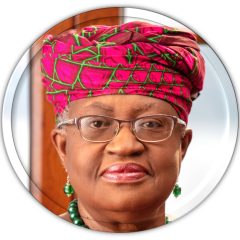
 Dr Ngozi Okonjo-Iweala
Leave a comment