- Secretary-General Baroness Patricia Scotland
- Honourable Ministers,
- Excellencies,
- I’m delighted to be here today. Let me start by thanking SG Scotland and the Commonwealth Secretariat for this timely gathering. I also want to express my gratitude for the Commonwealth’s continued support for the work of the WTO. My first external engagement after our successful 12th Ministerial Conference last June was the Commonwealth Heads of Government Meeting in Kigali. I had the opportunity to thank many of you, and your leaders, in person. Ministers from Commonwealth countries played a critical role at MC12 – three Vice Chairs were from Commonwealth countries, that is, Australia, Barbados and Uganda, as were most of the thematic facilitators: Jamaica, Kenya, New Zealand and Saint Vincent and the Grenadines.
- The Commonwealth Ministers successful role has led me to, like Oliver Twist, come here to ask for more. But beyond that the Commonwealth is a powerful economic and political force with a population of 2.7 billion, a third of the global population. With a GDP of $13.9 trillion almost 18% of global GDP in PPP terms and $2.91 trillion in merchandise exports or 13% of world exports, this is a group to be reckoned with. Getting your active support to move the WTO’s agenda will mean a pathway to unstoppable success. That is why I am here!
- As you know all too well, economic growth is slowing. This is mirrored in global trade: WTO economists estimate that goods trade volumes will grow by only 1.7% in 2023, before picking up speed to 3.2% in 2024. Slow growth is making debt distress worse, while making inflation, particularly for food and energy prices, even more painful for households.
- We all know that public frustration is growing. Further cause for concern comes from World Bank analysis suggesting that growth potential is declining within advanced and developing economies alike. That means that economies will not be able to grow as fast as they used to without triggering inflation. The Bank researchers find that the slowdown in trade in recent years is one factor in this decline, and believe that reinvigorating trade could help lift growth potential back up. As people around the world face a potential future of diminished economic prospects, the case for multilateral cooperation on trade to bolster growth and productivity, is stronger than ever. And yet, geopolitical tensions are creating pressures for fragmentation. These tensions coupled with the vulnerabilities we have seen in supply chains during the pandemic and the ongoing war in Ukraine have led to calls for reshoring, nearshoring, and friend-shoring. While some of this redirection of investment will be inevitable as the world tries to build resilience, we need to be vigilant to avoid a costly fragmentation of the multilateral trading system. Rather, building resilience should involve what we at the WTO are terming reglobalization – deeper, stronger, diversification of supply chains to include emerging markets and developing countries that have in place the right business environment to receive such investments. Working together and fostering global cooperation to enhance the functions of the Multilateral Trading System will be vital for the results the MTS and the WTO need to deliver going forward.
- This is why I have come to ask for your vigilance and continued support not only on these broader issues of global resilience but also on the immediate agenda of implementation of what we agreed at MC12 as well as preparation for our upcoming ministerial MC13 in Abu Dhabi in February 2024.
- My appeal you for support is the same I made at the recently concluded G7 leaders’ summit in Hiroshima and the APEC trade ministers’ meeting in Detroit. There, I heard two main priorities: (i) implementing what we agreed at MC12 and preparing for MC13 with particular focus on WTO reform, and (ii) addressing issues in the new trade agenda – such as digital trade, services, and climate change. I should say here that every minister I met with stressed the importance of dispute settlement and making the system fully functional. Today I want to remind you of the agreement we reached at MC12 and ask for your support to implement this, as well as work for MC13. I would also like if possible, to listen to your views and priorities.
- On MC12 implementation, as you know we reached a historic Agreement on Fisheries Subsidies. But it cannot start fighting the depletion of our oceans until it comes into force. This requires formal acceptance by two-thirds of the Membership.
- Seven Members have already ratified the agreement – among them Commonwealth countries Canada, the Seychelles and Singapore. Other non-commonwealth countries are Switzerland, the USA, Iceland and UAE. More ratifications are in the pipeline for the coming days, including Nigeria, the European Union and its 27 members which I am set to receive later this week. I am here to urge the rest of you to follow suit. There are 52 Commonwealth countries who are members of the WTO. You constitute 50% of the 110 members we need to get the Fisheries Subsidies Agreement into force. If you can all ratify the agreement by October, when we plan a senior officials meeting, this will guarantee entry into force by MC13. Many of you bear the costs of Illegal, Unreported and Unregulated fishing in or near your waters, and of subsidized fishing in overfished stocks and on the high seas. Africa alone sustains over $5 billion in economic losses every year due to IUU and overfishing. New WTO agreements normally take years to enter into force, but we can and should get this one done by MC13 – and I will be relentless in reminding you and other members about this. I have whispered that any minister whose country has not ratified the Fisheries Subsidies Agreement may not receive as warm a welcome as I would normally give at MC13. Let me also remind you that there is another very important reason to ratify. Our fisheries fund designed to help developing countries build fisheries management capacity and implement the agreement can only be accessed by developing country members who have ratified the agreement. The fund has now received commitments equivalent to almost $10 million and more support is coming in moving us closer to our goal of a $20 million fund. I am very grateful to the commonwealth members who have donated to the Fund i.e Canada and Australia. I understand the UK is contemplating a donation and we would very much welcome that. In parallel, the agreement reached at MC12 launched a second wave of negotiations on subsidies that contribute to overcapacity and overfishing, as well as related special and differential treatment for developing country Members and LDCs. Concluding these talks by MC13 is within our reach. But getting to a meaningful outcome requires all sides to come to compromise. When you ask for special and differential treatment, please be aware that some delicate issues are involved. There are certain large countries who are developing, and I don’t mean India who would benefit. This tends to make the matter difficult so it would be important to figure out how to handle this. Ongoing discussions in Geneva would benefit from the political push and flexibility that only ministers can provide. Your countries can play a valuable role here. Because of the diversity the Commonwealth represents – you are in many ways a microcosm of the WTO membership – you can serve as a laboratory to incubate ideas that could gain wider acceptance.
- Another key outcome from MC12 was the launch of a process of institutional reform, with a particular focus on dispute settlement, where you and your fellow Ministers committed to “discussions with the view to having a fully and well-functioning dispute settlement system accessible to all Members by 2024.”
- Just about everywhere I go – including the G7 and APEC – business and government stakeholders point to dispute settlement as a top priority for the WTO. We may not be able to deliver everything by MC13, but coming away from there empty-handed on this issue will not be good for the WTO’s credibility. We should at the very least seek to converge on principles and an institutional framework for dispute settlement reform. And where there is convergence on particular elements, we should be able to capture this progress before or at MC13, while continuing work on the outstanding issues. I urge you to stay engaged with the ongoing technical discussions in Geneva with an open mind, and to reach out to other members, [particularly the USA,] to find solutions.
- Wider work on WTO Reform is on a positive path, with Members meeting in various configurations and translating their expressed views into formal written proposals in areas such as industrial subsidies; policy space; environmental challenges, climate change and issues of the global commons; as well as outreach to the private sector. The Chairperson of the General Council will next week convene an informal meeting to serve as a safe space for members to discuss the WTO’s deliberative function and institutional issues.
- Turning now to agriculture and development, and scope for action between now and MC13.
- You and your colleagues took important steps forward on food security at MC12. You smoothed the flow of emergency food aid by agreeing to exempt World Food Programme humanitarian purchases from export restrictions. You also pledged to keep food flowing across borders. Enhanced WTO monitoring of export restrictions on food, feed, and fertilizer introduced since the start of the war in Ukraine has helped calm price volatility by bringing the number of such measures down from 101 to 63 – movement in the right direction, though there is a lot of room to improve. Nevertheless, we were unable to take meaningful steps forward on reforming the WTO rulebook for agriculture trade. Even as climate and other sustainability impacts loom as growing threats to future food supplies, most of our rules for farm trade date back to the mid-1990s. The agriculture sector, and specifically key products like cotton, continue to be distorted by high levels of subsidies and protection. And with over a quarter-billion people facing crisis or worse levels of acute food insecurity last year, according to a new report from the Food Security Information Network (a consortium of UN, regional, national, and non-governmental agencies), we have a long way to go on food security.
- We cannot keep failing on this front. Nor can we keep doing what we have been doing for the past twenty-plus years and expect different results. To this end, negotiators in Geneva are now trying to look at agriculture through a food security lens. They have had useful discussions on domestic support and public stockholding, as well as workshops on trade-related financing for agriculture and building productive resilience. But substantive progress is slow. To set us up to deliver meaningful results, Geneva-based officials need to converge on the “collective what” they are trying to accomplish on agriculture at MC13 so they can get to determining the “collective how”.
- Development is another critical issue with ramifications across the entire spectrum of the WTO’s work. We know that the shocks of the past three years have set back years of progress in many developing economies, particularly in Africa. While development is an issue that goes far beyond the negotiations on special and differential treatment, I am heartened by Members’ recent reinvigoration of discussions on the G90’s Agreement Specific Proposals. We can deliver on at least some of these proposals, and on issues of LDC Graduation, well before MC13 – perhaps by the senior officials meeting we are planning in late October to prepare for MC13. I have also been urging delegations to take a broader perspective on development issues. How can we create a better enabling environment for poorer Members to attract investment, to add value to goods and services, to trade more, create jobs and grow their economies? These are the goals we need to deliver on.
- Many of you are part of the plurilateral negotiations on Investment Facilitation for Development, which currently counts 77 developing country members. Delivering this by MC13 would help many of your countries start attracting more investment.
- Before concluding, Excellencies, I want to speak to the new trade agenda. Investment facilitation, which I already mentioned, is one part of this. Another is digital trade, which is growing much faster than trade in goods and other services, and accounts for a rapidly increasing share of global commerce. MC12 extended the E-Commerce Moratorium, to great acclaim from the private sector. Here we need to work hard to reach a collective agreement on where this is going. The WTO can continue to play its historic role of fostering predictability and openness. Alongside these discussions, nearly 90 members, many of them developing countries, are negotiating a shared set of rules for digital trade.
- On the moratorium as well as the other issues I have mentioned, please encourage your representatives in Geneva to work together, and empower them to get things done. There are additional new issues we need to come to grips with as well. These include climate change and other environmental issues, including plastics pollution, where cooperation on trade would be a force multiplier for the pursuit of green goals. We can also do more to make trade a stronger force for socioeconomic inclusion, by bringing more women and micro, small, and medium-sized enterprises into cross-border production networks. At MC13, we can look to update the WTO’s deliberative function, so that members can more easily discuss new issues as they arise and respond to them as needed. So I ask that you put on your thinking caps about how best to create space for such deliberation within the WTO.
- As I said at the outset, Excellencies, people around need the WTO to keep delivering. The Commonwealth, which includes economies rich and poor, big and small, can once again help the wider WTO membership get there. I hope our discussions today provide a much-needed boost to our work in Geneva.
- Thank you.
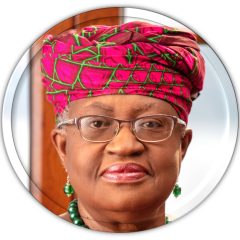
 Dr Ngozi Okonjo-Iweala
Leave a comment